Sputter Erosion Measurement
Results
This
document gives results of sputter erosion experiments performed by cavity
ring-down spectroscopy (CRDS) and presents the method of obtaining numerical
values of number density, electronic temperature, and an approximation to
translational temperature using the theory and formulae discussed in the previous
chapters. As mentioned earlier, Titanium and molybdenum results are only presented.
5.1 Acquisition
of Absorbance Spectrum
The
oscilloscope records the PMT signal and is as shown in figure 4.1. The signal
on the scope is transferred to a computer using a GPIB card (National
Instruments). The PMT trace is negative and is converted to a positive signal
by multiplying by -1. The PMT trace is fit with an exponential to yield the
ring-down (1/e) time. The exponential fit uses data between 90% and 10% of the
maximum signal amplitude. The 90-10 fitting improves the fidelity, and is used
to exclude early data, and the data in the tail, both of which are subject to
interferences. The laser is wavelength scanned in order to collect the
absorbance spectrum. Thus as a function of wavelength, ringdown
times are obtained and stored in a text file. The above tasks are controlled by
a custom written Labview code.
The
text file contains two columns of data: wavelength and ring down time. Equation
3.x is used to infer absorbances from the ring-down
times. To get the absolute absorbance, the empty cavity baseline should be
subtracted. Typically, peakfit is used to fit and
subtract the baseline, thus yielding absolute absorbance versus wavelength
(absorbance spectrum). In order to determine particle number densities, the
wavelength-integrated areas of the absorbance profiles are needed (Equation
3.x). Peakfit has numerical routines to fit various
lineshapes (Gaussian, Lorentz, Voigt
etc.) and thus is a useful tool to obtain the required absorbance areas.
5.2 Sputtering
of Titanium by Argon Ions
In
these experiments, an argon beam with 750eV energy and a current of 18mA is
incident on a Ti target. The absorbance model is used to determine appropriate
wavelength scanning regions for CRDS experiments. Based on the model output,
the titanium absorbance spectrum is recorded by CRDS in the vicinity of 395 nm.
Figure 5.3 shows the absorbance spectrum of titanium: symbols are the
experimental data, the solid line is the spectrum fitted to peaks (using Peakfit), and the dotted line is the simulated spectrum
from the absorbance model (using the measured Telec=1570
K, and with line broadening matched to data).
The absorption lines are the electronic titanium transitions and are
labeled in the figure 5.1.
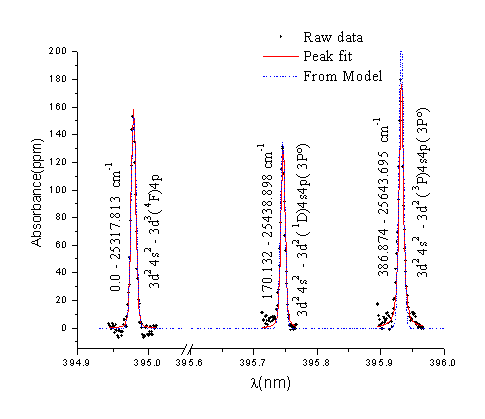
Figure
5.1 Titanium absorbance spectrum recorded by CRDS.
From
the absorbance spectrum, the area under each peak is determined using Peakfit analysis and the number density of atoms present in
each energy level is calculated from Equation 3.x as shown in Table 5.1. The
distribution of energy levels for titanium is such that for the excitation
temperatures of interest, virtually all of the population resides in the three
measured states. Therefore, the overall titanium number density can be
determined by adding the populations of the three measured states. Assuming a
path length of 8cm, the spatially averaged number density of sputtered titanium
atoms obtained is 6.5±0.6x108 cm-3. The error bar
corresponds to one standard deviation and arises
primarily form uncertainties in the fitted areas.
|
Titanium sample calculation table |
|
|
|
|
|
|||
|
lactual(nm) |
Area(ppm-nm) |
gk |
gi |
Ei(J) |
Ek(J) |
Aki(s-1) |
ln(Area/l4*gk*Aki) |
Ni(m-3) |
|
394.979 |
1.4225 |
3 |
5 |
0 |
5.02E-19 |
4.85E+07 |
-42.35880553 |
1.89E+14 |
|
395.745 |
1.25 |
5 |
7 |
3.38E-21 |
5.05E-19 |
3.00E+07 |
-42.52642072 |
2.24E+14 |
|
395.933 |
1.95 |
7 |
9 |
7.68E-21 |
5.09E-19 |
4.04E+07 |
-42.71838719 |
2.38E+14 |
Table
5.1 Titanium calculations. Ni is the spatially averaged number
density in the three energy levels probed. The sum of these Ni
yields the overall titanium number density.
Figure
5.2 shows a Boltzmann plot, the slope of which is
 from
which electronic temperature, Telec is
determined. Note that the electronic temperature is the temperature describing
the populations of electronic energy levels. The slope of the plot is –4.67x10¹⁹
and the error associated with the measurement is 3%, which yields electronic
temperature of 1550+/-50 K. Number density can also
be calculated by knowing the population
of a single state in combination with the measured electronic excitation temperature.
(Owing to the linearity of the Boltzmann plot both
methods give consistent results.)
from
which electronic temperature, Telec is
determined. Note that the electronic temperature is the temperature describing
the populations of electronic energy levels. The slope of the plot is –4.67x10¹⁹
and the error associated with the measurement is 3%, which yields electronic
temperature of 1550+/-50 K. Number density can also
be calculated by knowing the population
of a single state in combination with the measured electronic excitation temperature.
(Owing to the linearity of the Boltzmann plot both
methods give consistent results.)
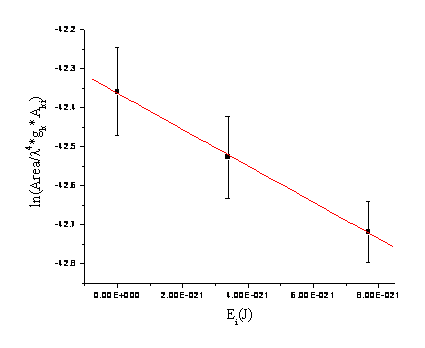
Figure 5.2. Boltzmann plot for determining electronic temperature. The slope yields
Telec=1550+/- 50 K.
To understand the dependence of number density on beam
current, we varied the beam current and collected the absorbance spectra.
Figure 5.3 shows the absorbance profiles for a single absorption feature at
various ion beam currents. The number densities are calculated from the area
under the peak for each case and a plot of number density Vs beam current
is obtained. Figure 4.6 shows the number density of sputtered titanium for
beam currents of 10, 14, and 18 mA respectively. Neglecting beam-focusing
effects, the dependence of the number density on beam current should be linear
and through the origin. Figure 5.4 indeed shows a best fit line constrained
to pass through the origin that well describes the data (R2=0.9821).
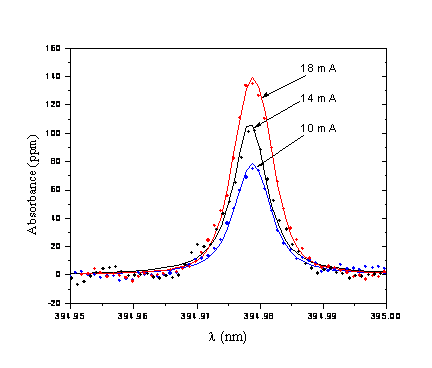
Figure
5.3 Titanium Absorption feature at 394.979 nm collected for different beam
currents of 10,14, and 18 mA.

Figure
5.4 Titanium number density versus beam current.
5.2.1
Comparison of Titanium CRDS Data with Sputter Model
One
can compare the number densities obtained by CRDS with estimates from a simplified
sputtering model. The model assumes a cosine-distribution for the sputter
yield and uses the experimental beam current and target/optical-axis geometry
(Fig.3.2). As mentioned, the ion beam has an active area of 8 cm by 2.5 cm
(with the 8 cm extent oriented parallel to the optical axis), and the optical
axis is 7.8 cm from the target. A total sputter yield of 0.7+/-0.2 is adopted
for titanium [reference11]. The sputter model requires the angular profile
of (average) ejected velocity of the sputtered particles, which have been
found using the TRIM sputtering simulation software [reference12]. Using these
parameters and the sputtering model in Chapter 2, the number density profile
along the beam is determined, which then is integrated to yield the path-integrated
number density. (The chamber has a diameter of 20 cm, so the model profiles
are truncated accordingly, “losing” about 15% of the integrated number density.).
For
the 18 mA beam current, the sputter model yields a path-integrated titanium
number density of 5.9+/-1.7x109 cm-2, while the corresponding
value measured by CRDS is 5.1+/-0.5x109 cm-2. One could
use the shapes of the modeled number density profiles and scale them according
to the measured path-integrated number densities as a means to obtain spatially
resolved profiles from the CRDS data. The CRDS and sputter model give consistent
values for titanium. Note that in many cases (e.g. sputter yield not known,
material not well characterized) it would not be possible to model the sputtering
and an experimental approach such as CRDS is required.
5.2.2
Titanium Translational Temperature from CRDS
The
determination of erosion rate or flux of sputtered particles requires the
knowledge of two parameters namely number density and velocity of sputtered
particles. This thesis does not cover the full details of obtaining the velocity
of sputtered particles, but in future work, obtaining velocity measurements
using CRDS is discussed. The lineshapes obtained
in the CRD spectra are indicative of the velocities of the sputtered particles.
The current experiments operate at low pressures and with relatively narrow
linewidth lasers (~0.002 nm), and so the width of the measured
lines is dominated by Doppler effects, owing to velocity components in the
direction parallel to the probe laser beam. The symmetry is such that there
is no bulk-velocity component along the optical axis, and therefore no net
Doppler shift. From the Peakfit analysis, the Full-Width
at Half-Maximum (FWHM) of the absorbance peaks for titanium is found to be
7.5+/-0.8 pm. And therefore, translational temperature can be approximated
as 34000 ± 4000 K (~2.9 eV) (equation 3.x). The
effective translational temperature corresponds to the velocity projection
along the optical axis, weighted by the number density, and is reasonably
consistent with values from the modeling.
5.2.3
Sensitivity of CRDS for Titanium Number density Measurement
The noise
in the CRDS measurements enables the determination of the detection limits
of the current system. The noise in the absorbance baseline is ~2 ppm for titanium. The baseline noise can be used to predict
detection limits for the present conditions. For the absorption line at 379.979
nm, the peak absorbance measured is 140 ppm corresponding
to a number density of 6.5+/-0.6x108 cm-3. Scaling these
values, 2 ppm corresponds to a number density of
~9x106 cm-3. Thus the minimum detectable number density
of the CRDS system for Ti is ~9x106 cm-3 for a collection
time of about 30 seconds and over a path length of 8 cm.
5.3 Sputtering
of Molybdenum by Argon Ions
In
these experiments, an argon beam with 750eV energy and a current of 18mA is
incident on molybdenum target. The absorbance model is used to determine appropriate
wavelength scanning regions for CRDS experiments. Based on model output, the
molybdenum absorbance spectrum is recorded by CRDS in the vicinity of 379.9
and 386.5 nm. Figure 5.5 shows the absorbance spectrum of molybdenum, symbols
are the experimental data, solid line is the spectrum fitted to peaks (using
peakfit), and dotted line is simulated spectrum
from the absorbance model (using Telec=1570
K, and with line broadening matched to data).
The absorption lines are both electronic transitions from the ground
state and are labeled in the figure. The next lowest energy level is at 10,768 cm-1, so that Boltzmann calculation
reveals that to a good approximation all population is in the ground state
(and the exact temperature used in our simulations is inconsequential).
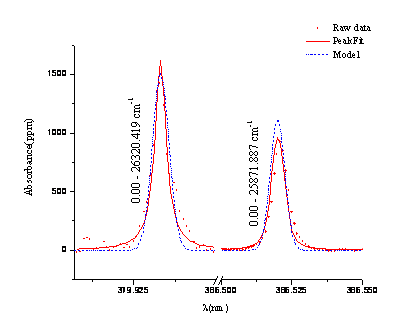
Figure
5.5 Molybdenum absorbance spectrum recorded by CRDS
From
the absorbance spectrum, the area under each peak of the absorbance spectrum is
determined using Peakfit analysis. Therefore, one can use the area (from Peakfit) of either measured line to determine the ground
state population, and set this equal to the total molybdenum population. To
find (spatially averaged) number densities, a path length of 8cm (corresponding
to the ion beam extent) is assumed, yielding 5.1±0.5x108 cm-3
for the given conditions. The error bar on the measurement is obtained from the
peakfit area fit and corresponds to one standard
deviation.
Again the beam current is varied to study the number
density dependence. Figure 5.6 shows the absorbance profiles for a single
absorption feature at various ion beam currents. The number densities are
calculated from the area under the peak for each case and a plot of number
density Vs beam current is obtained. Figure 5.7 shows the number density of
sputtered molybdenum for beam currents of 10, 14, and 18 mA respectively. Neglecting
beam-focusing effects, the dependence of the number density on beam current
should be linear and through the origin. Again, Figure 5.7 shows a fitted
straight line constrained to pass through the origin (R2=0.9874)
indicating the expected dependence.
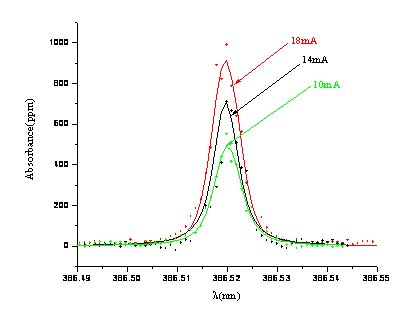
Figure
5.6 Single Absorption feature at 386.5nm for different beam currents
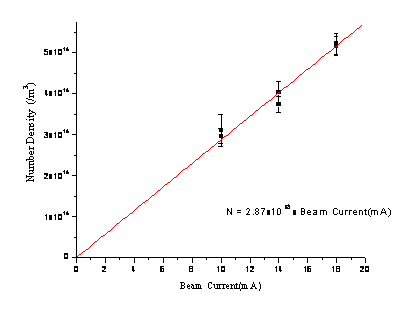
Figure
5.7 Molybdenum number density versus beam current
4.3.1
Comparison of Molybdenum CRDS Data with Sputter Model
One
can compare the number densities obtained by CRDS with estimates based on a
simplified sputtering model. Assume a cosine-distribution for the sputter yield
and use the experimental beam current and target/optical-axis geometry
(Fig.3.2). As mentioned, the ion beam has an active area of 8 cm by 2.5 cm (with
the 8 cm extent oriented parallel to the optical axis), and the optical axis is
7.8 cm from the target. Sputter yields of 0.9+/-0.9 are adopted for molybdenum
[reference11]. The sputter model requires the angular profile of (average)
ejected velocity of the sputtered particles, which have been found using the
TRIM sputtering simulation software [reference12]. Using these parameters and
the sputter model in chapter 2, the number density profile along the beam is
determined, which then is integrated to yield the path-integrated number
density.
For
the 18 mA beam current, the sputter model yields a path-integrated molybdenum
number density of 9.9+/-3.3x109 cm-2, while the corresponding
value measured by CRDS is 4.1+/-0.4x109 cm-2. While
the CRDS and sputter model give consistent values for titanium, there is a
discrepancy of roughly a factor of 2 for molybdenum. Given the simplicity
and potential shortcomings of the sputter model, one can view this as reasonable
agreement. Note that the modeling approach may suffer from the following:
incorrect total sputter yields from the literature, incorrect ejected velocities
from TRIM, non-cosine behavior of the sputter yield, divergence or focusing
effects of the ion beam, and target material preparation or contamination
effects.
4.3.2
Molybdenum Translational Temperature from CRDS
From
the peak fit analysis, the Full-Width at Half -Maximum (FWHM) of the absorbance
peaks for molybdenum is 6.4+/-0.4 pm. This FWHM corresponds to a translational
temperature of approximately 51000 ± 3000 K (~4.4 eV)
(equation 3.xx).
4.2.3
Sensitivity of CRDS for Molybdenum Number density Measurement
The baseline
noise in the CRDS measurements enables the determination of the detection
limits of the current system. For the molybdenum measurements, the noise in
the absorbance baseline is also ~2 ppm (for the
386.5 nm feature). This yields a minimum detectable number density of ~7x10⁵
cm-3 for a collection time of about 30 seconds and over a path
length of 8 cm. (The baseline noise for the 379.9 nm feature is larger owing
to lower mirror reflectivity at this wavelength.).
The CRDS detection limits are more than adequate to
detect the number densities commonly of interest in EP applications, and
compare favorably to those found in laser induced fluorescence (LIF)
experiments. For example, Orsitto et al. used a
calibration lamp to quantify an LIF measurement scheme and estimated a
detection limit of ~2.5x108 cm-3 for molybdenum number
density measurements near the toroidal limiter of a
Tokomak (for a scattering volume of ~2x10⁻⁷ m-3). Gaeta et al used LIF to make measurements of sputtered
particles for EP investigations but did not quantify the number densities
[reference 13].